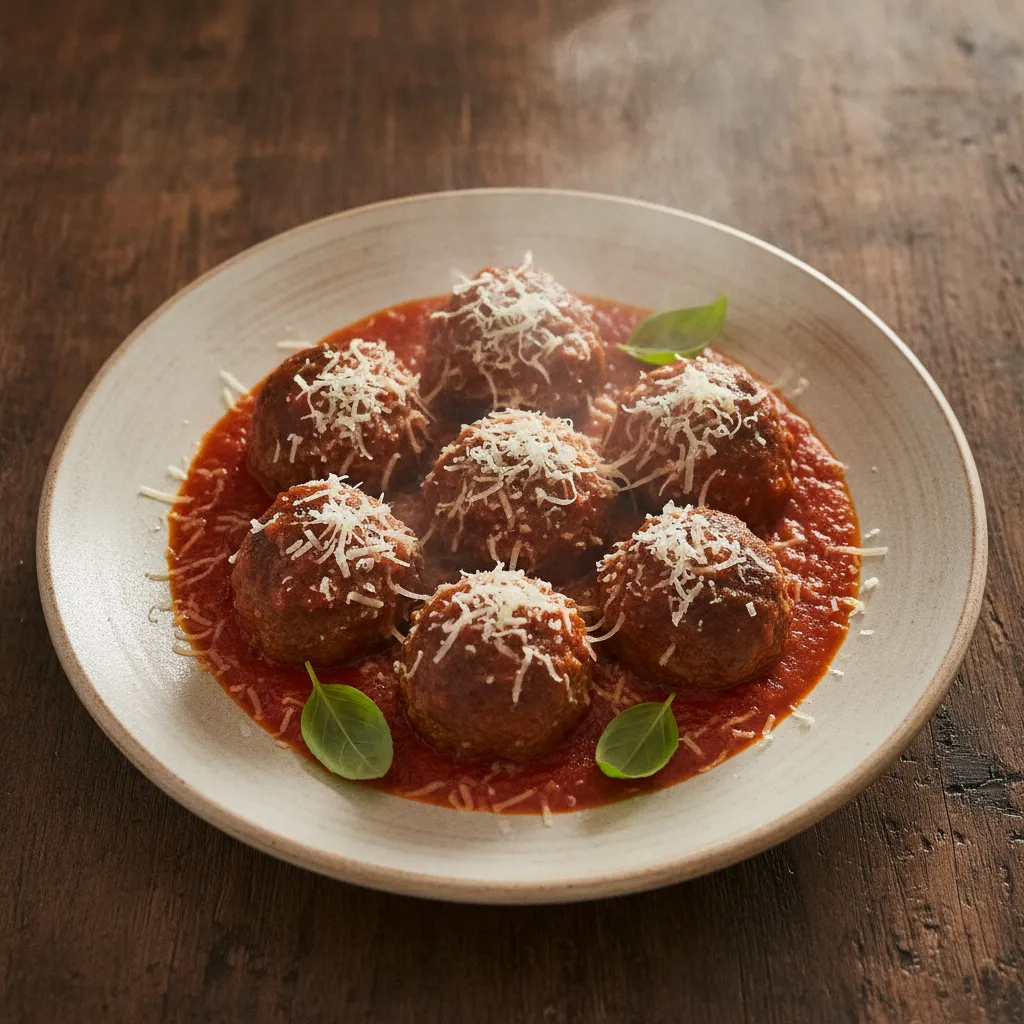
A great meatball has three jobs: stay tender, hold its shape in sauce, and taste like the meat first with seasoning second. The difference between dense, dry meatballs and juicy ones comes down to five fundamentals: a panade binder, gentle mixing, proper fat content, correct internal temperature, and a short rest.
This guide walks through each step with the science explained so you can adapt any recipe and fix common failures.
Prep time: 10 minutes. Cook time: 20-25 minutes. Servings: 4 (about 16 meatballs).
Key Takeaways
- Panade beats egg alone. Milk-soaked panko traps steam and fat so meatballs stay tender even after simmering or freezing.
- Mix until just combined. Over-mixing activates proteins and turns meatballs rubbery. Stop the second the mixture looks uniform.
- 80/20 or 85/15 ground meat gives the best balance of flavor and moisture. Leaner than 90/10 dries out.
- Cook to 160F (71C) internal. Use a thermometer. Color is unreliable and overcooking by even 5 degrees dries the meat.
- Rest 5 minutes. Juices redistribute from the surface into the center. Skipping this step loses moisture when you cut or sauce.
How to Make Meatballs
-
Make the panade. In a large bowl, stir the panko and milk together. Let it sit for 5 minutes until the milk is absorbed and the crumbs are soft. This is the moisture insurance policy.
-
Mix gently. Add the ground meat, egg, cheese, garlic, salt, pepper, and oregano to the bowl. Mix gently with your hands until just combined. Stop the moment it looks uniform. Over-mixing makes meatballs dense and tough.
-
Shape. Roll into 16 balls about 1.5 inches across. Place on a parchment-lined sheet pan. Do not pack them tight; loose shaping leaves room for the panade to expand.
-
Cook. Bake at 400F (200C) for 18 to 20 minutes until the centers reach 160F (71C). Or pan-fry in a thin film of oil over medium heat, turning every 2 minutes until browned on all sides and cooked through.
-
Rest. Remove from heat and let the meatballs rest 5 minutes before serving or adding to sauce. This keeps the juices inside instead of on the cutting board.
Ingredients
- 1 lb (450 g) ground meat (beef 80/20, turkey, pork, or a 50/50 beef-pork blend)
- 1/2 cup panko breadcrumbs
- 1/4 cup whole milk
- 1 large egg
- 1/2 cup grated Parmesan or pecorino Romano
- 2 cloves garlic, minced
- 1 tsp kosher salt
- 1/2 tsp black pepper
- 1 tsp dried oregano or Italian seasoning (optional)
Why These Techniques Work
Panade (the non-negotiable)
A panade is starch soaked in liquid. The starch gelatinizes during cooking and forms a gel that traps moisture and fat. Without it, the meat proteins tighten, squeeze out water, and you get dry, dense balls. Milk adds fat and lactose for browning; water works in a pinch but milk is superior.
Mixing science
Ground meat contains myosin and actin. Vigorous mixing aligns these proteins into a tight network that expels water and creates a bouncy, sausage-like texture. Gentle mixing keeps the network loose. You should still see small flecks of distinct fat and meat after mixing.
Fat content
Fat carries flavor and melts into the meat during cooking, keeping it moist. 80/20 beef or a beef-pork blend is ideal. Turkey and chicken need extra fat (add 1 Tbsp olive oil per pound) or they dry out.
Internal temperature
The USDA sets 160F (71C) for ground meat because bacteria can be distributed throughout, not just on the surface. An instant-read thermometer is the only reliable check. Color changes at different temperatures depending on fat and pH, so do not rely on browning.
Resting
When meat cooks, juices are driven toward the surface by heat. Resting lets capillary action pull some of that moisture back into the center. Five minutes is enough for 1.5-inch meatballs. Larger meatballs need 8-10 minutes.
Common Failures and Fixes
| Problem | Cause | Fix |
|---|---|---|
| Meatballs fall apart in sauce | No binder or panade skipped | Always make panade first; add 1 Tbsp extra panko if mixture feels wet |
| Tough, rubbery texture | Over-mixed | Mix only until uniform; stop and shape even if small lumps remain |
| Dry centers | Lean meat + no rest | Use 80/20 or add oil to lean blends; rest 5 minutes minimum |
| Greasy exterior | High heat frying or cheap meat | Bake instead of fry, or use 80/20 not 70/30 |
| Bland flavor | Under-seasoned or low-fat meat | Salt the mixture directly; fat carries flavor, so do not use 93/7 |
Freezing and Make-Ahead
- Freeze raw: Roll, freeze on a sheet pan until solid, then bag. Cook from frozen, adding 5 minutes to bake time.
- Freeze cooked: Bake, cool completely, freeze flat, then bag. Reheat in sauce or 350F oven for 12 minutes.
- Fridge: Raw mixture keeps 24 hours. Cooked meatballs keep 4 days.
FAQ
Can I skip the egg?
Yes. The panade and cheese provide enough binding for most mixtures. Use the egg only if the mixture feels very loose or you are making very large meatballs.
Why do my meatballs shrink so much?
High heat drives out moisture fast. Lower the oven to 375F or simmer gently instead of boiling. Also check fat content - very lean meat shrinks more.
Can I use fresh breadcrumbs instead of panko?
Panko is drier and creates a lighter panade. Fresh breadcrumbs add extra moisture that can make the mixture sticky. If using fresh, reduce milk by 1 tablespoon.
How do I make gluten-free meatballs?
Substitute gluten-free panko or crushed gluten-free crackers. The panade step still works the same way.
What is the best panade ratio?
1/2 cup dry crumbs to 1/4 cup liquid per pound of meat is the sweet spot. Too much liquid makes the mixture hard to shape; too little and you lose the moisture benefit.
Sources
- USDA Food Safety and Inspection Service: Ground Beef and Food Safety (160F internal temperature requirement)
- Serious Eats: The Science of Meatballs (panade technique and protein behavior research)
- Bon Appetit: Why Resting Meat Matters (juices and carryover cooking)
- New York Times Cooking: Classic Meatball Technique (mixing guidelines)
Related Recipes
- Classic Beef Meatballs in Marinara - the base recipe this guide expands
- Italian Sunday Meatballs - slow-simmered with Sunday gravy
- Air Fryer Meatballs - 12-minute crispy alternative
- Swedish Meatballs with Cream Gravy - panade technique in a different cuisine
- Greek Lamb Meatballs (Keftedes) - Mediterranean herbs and tzatziki