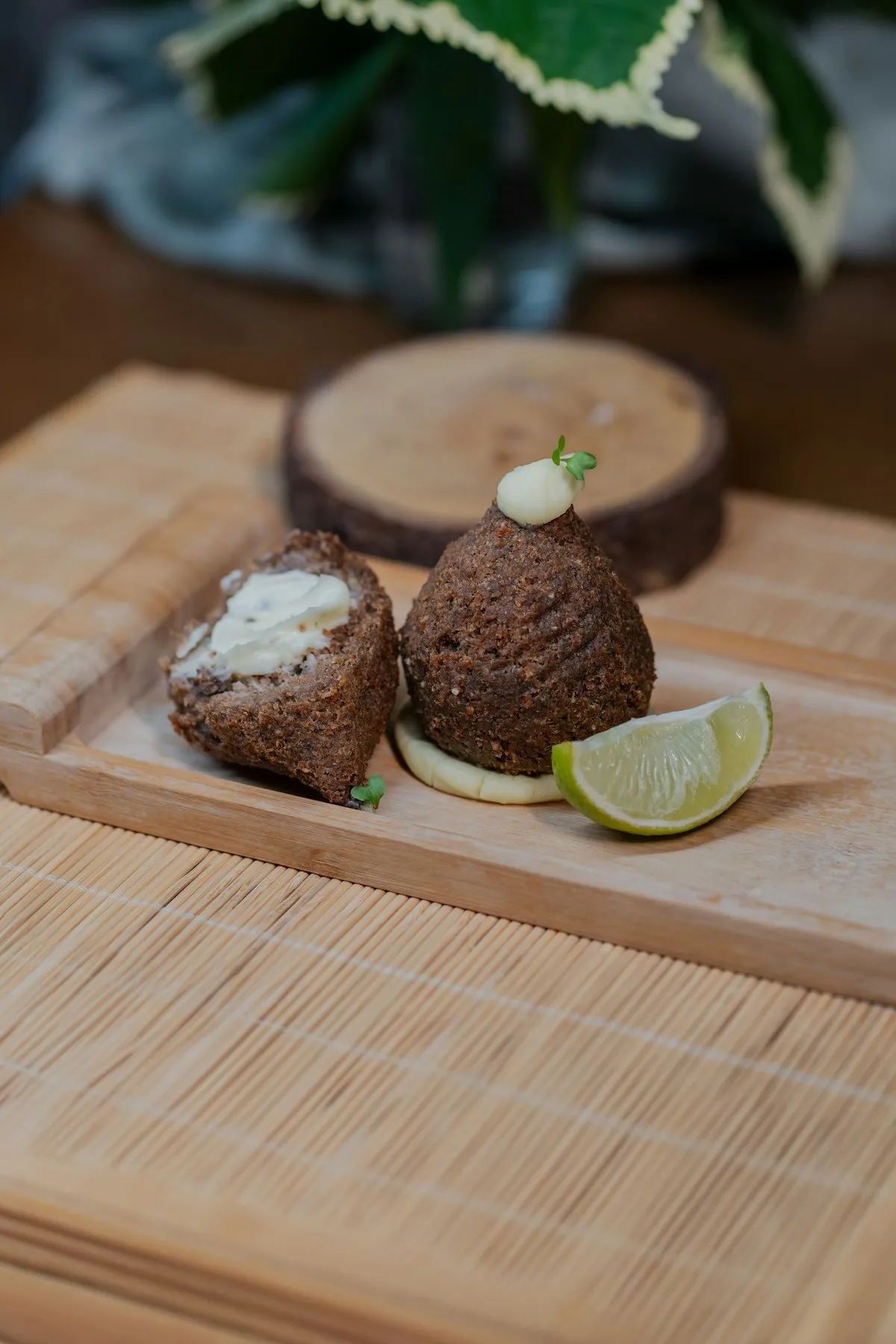
Lebanese kibbeh is the national dish of Lebanon - a crispy, football-shaped shell of bulgur wheat and lamb wrapped around a spiced pine nut filling. Found on every mezze table from Beirut to the Lebanese diaspora worldwide, kibbeh is more than a meatball. It is a technique.
The shell is made from fine bulgur wheat blended with extra-lean lamb and processed into a smooth, elastic paste. The filling combines spiced lamb with toasted pine nuts and warm allspice. When fried until deep golden, the bulgur crust shatters on the first bite, giving way to the savory filling inside.
Prep time: 45 minutes. Cook time: 30 minutes. Servings: 4 (about 20 pieces).
Key Takeaways
- Fine bulgur is non-negotiable. Medium or coarse bulgur will not process into the smooth paste the shell needs. Look for it at Middle Eastern grocers or online.
- Squeeze the bulgur dry before processing. Wet bulgur makes the shell paste too loose and it cracks during frying.
- Process the shell paste for 3 to 4 minutes. Under-processed paste will not hold together. It should feel sticky and elastic, like a smooth dough.
- Keep everything cold. Warm shell paste softens and tears. Refrigerate portions you are not actively shaping.
- 350F (175C) oil. Too hot and the shell darkens before the filling heats. Too cool and the kibbeh absorbs oil and turns greasy.
How to Make Lebanese Kibbeh
- Soak the bulgur. Place the fine bulgur in a bowl, cover with cold water, and let it soak for 15 minutes. Drain well and squeeze out excess moisture with a clean towel. (See prep hint: Squeeze Dry)
- Make the shell paste. Add the soaked bulgur, 1 lb lamb, quartered onion, allspice, cinnamon, salt, and pepper to a food processor. Process for 3 to 4 minutes until the mixture is smooth and paste-like. It should feel sticky and hold together when pressed. (See prep hint: Process Until Smooth)
- Toast the pine nuts. Heat a dry skillet over medium heat. Add pine nuts and stir for 2 to 3 minutes until golden. Remove immediately to a plate.
- Cook the filling. In the same skillet, heat 1 tbsp oil. Sauté diced onion for 3 to 4 minutes until soft. Add 1/2 lb lamb, allspice, cinnamon, and salt. Cook for 5 to 6 minutes, breaking it up, until browned. Stir in toasted pine nuts and let cool.
- Shape the kibbeh. Divide the shell paste into 20 equal portions. Flatten each into a thin oval, about 3 inches long. Place 1 tsp filling in the center. Fold the shell over and pinch the seam shut, shaping into a pointed football. Keep hands wet to prevent sticking. (See prep hint: Wet Hands for Shaping)
- Fry. Heat oil in a deep skillet to 350F (175C). Fry kibbeh in batches for 3 to 4 minutes, turning once, until deep golden brown. Drain on paper towels.
Ingredients
For the shell:
- 1/2 cup fine bulgur wheat
- 1 lb (450 g) extra-lean ground lamb (or beef-lamb blend), 90/10
- 1 small yellow onion, quartered
- 1 tsp ground allspice
- 1 tsp ground cinnamon
- 1 tsp salt
- 1/2 tsp black pepper
For the filling:
- 1/4 cup pine nuts, toasted
- 1 small onion, finely diced
- 1/2 lb (225 g) ground lamb
- 1 tsp ground allspice
- 1/2 tsp ground cinnamon
- 1/4 tsp salt
For frying:
- Vegetable oil, about 2 cups
Tips for Perfect Kibbeh
- Extra-lean meat is essential. Fatty meat makes the shell paste too soft to shape. Ask your butcher to grind leg of lamb twice, or use 90/10 ground lamb.
- Food processor is the way. Traditional kibbeh was pounded in a stone mortar, but a food processor gives the same smooth result in minutes. Do not pulse - run it continuously for 3 to 4 minutes.
- Work in small batches. Divide the shell paste and keep unused portions covered in the fridge. Warm paste loses elasticity.
- The football shape matters. The pointed oval is not just traditional - it helps the kibbeh cook evenly and gives the classic crunch on the ridges.
- Bake instead of fry. Place shaped kibbeh on a parchment-lined sheet pan, brush with oil, and bake at 425F (220C) for 20 to 25 minutes, turning once. Less messy, still crispy.
What is Kibbeh?
Kibbeh (also spelled kibbe, kubba, or kibbi) is a family of dishes built on the same core technique: bulgur wheat blended with raw lamb into a smooth paste, then shaped and cooked. The name comes from the Arabic verb meaning “to form into a ball.”
In Lebanon, kibbeh appears in more than a dozen forms - fried balls, baked trays, raw tartare, simmered in yogurt, or stuffed with cheese. This recipe covers the most iconic version: fried kibbeh (kibbeh bil sanieh for baked, kibbeh nayyeh for raw). If you enjoy lamb-based meatballs, you might also like our Greek lamb meatballs (keftedes).
The dish is shared across the Levant - Syria, Palestine, Jordan, and Iraq all have their own variations. But Lebanese kibbeh is widely considered the gold standard.
Storage and Make-ahead
- Fridge: shaped, uncooked kibbeh keeps covered for up to 24 hours. Fry straight from the fridge.
- Freezer: place shaped kibbeh on a sheet pan and freeze until solid, about 2 hours. Transfer to a freezer bag for up to 3 months. Fry from frozen, adding 1 to 2 minutes to cook time.
- Leftovers: fried kibbeh keeps in the fridge for 3 to 4 days. Reheat in a 375F (190C) oven for 10 minutes to restore crispiness.
Frequently Asked Questions
What is the difference between kibbeh and regular meatballs?
Kibbeh uses bulgur wheat blended with raw meat to form the outer shell, while regular meatballs are pure ground meat mixed with breadcrumbs. Kibbeh also has a separate spiced filling inside the shell, giving it two distinct layers of flavor and texture.
Can I use beef instead of lamb?
Yes, but use extra-lean ground beef (90/10 or leaner). Lamb is traditional and has a richer flavor that pairs well with allspice and cinnamon. A 50/50 beef-lamb blend is a good compromise.
Where do I find fine bulgur wheat?
Middle Eastern grocery stores, specialty food shops, and online retailers carry fine bulgur. It is sometimes labeled as bulgur #1 or coarse bulgur. Do not confuse it with medium or coarse bulgur, which is too grainy for the shell paste.
Can I bake kibbeh instead of frying?
Absolutely. Place shaped kibbeh on a parchment-lined baking sheet, brush or spray with oil, and bake at 425F (220C) for 20 to 25 minutes, turning once halfway through. The texture will be slightly less crispy but still delicious.
What do you serve with kibbeh?
Kibbeh is traditionally part of a mezze spread alongside hummus, tabbouleh, baba ganoush, and pickled vegetables. For more Middle Eastern meatball styles, see our kofta guide or browse the Indian meatball recipes collection. It is also served as a main dish with yogurt sauce (kibbeh labanieh) or a simple salad.