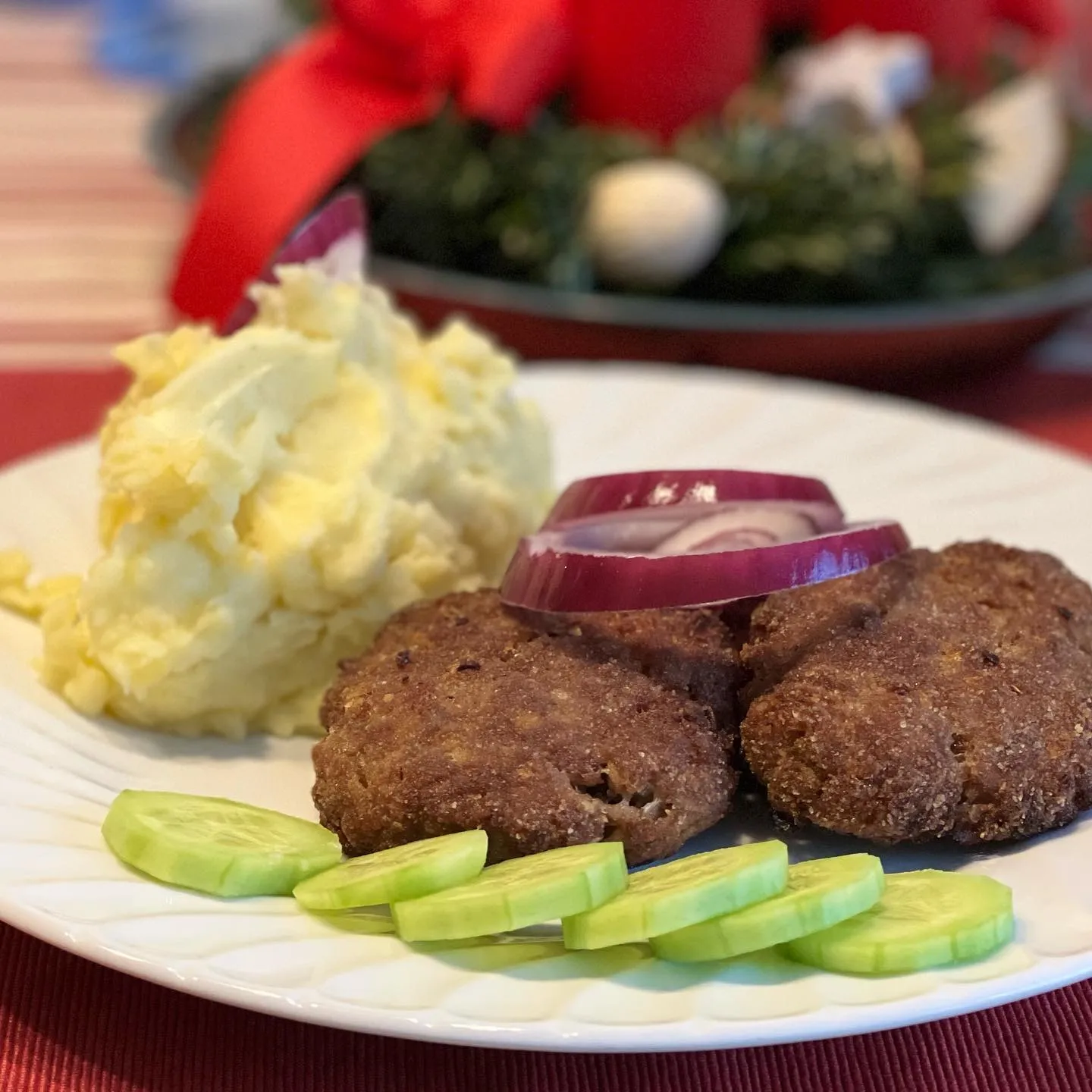
Faschierte Laibchen are traditional Austrian meat patties - the Viennese cousin of the German Frikadelle and Danish Frikadeller. Made from a 50/50 blend of ground beef and pork, mixed with milk-soaked bread, fresh marjoram, and pan-fried in butter until golden and crispy. This is Austrian Hausmannskost at its best - simple home cooking that has fed Vienna for generations.
The secret is the bread-milk panade. Cubes of stale Kaiser roll soaked in warm milk, squeezed dry, and folded into the meat create a light, juicy texture that keeps the patties tender through pan-frying. Add fresh marjoram - the signature herb of Austrian meat dishes - and you have the classic flavor profile that appears on every Gasthaus menu from Vienna to Salzburg.
Key Takeaways
- 50/50 beef and pork blend - the fat ratio creates juicy, flavorful patties. All-beef works but loses the traditional richness.
- Milk-soaked bread panade - Kaiser roll cubes soaked in warm milk, then squeezed dry. This is what keeps the patties tender, not dense.
- Fresh marjoram - the signature Austrian herb. Dried works but fresh is noticeably brighter.
- Pan-fry in butter - butter gives the golden crust that oil alone cannot replicate. Clarified butter is the traditional choice.
- Classic breading optional - the traditional version uses flour-egg-breadcrumb coating. Unbreaded patties are also common.
How to Make Austrian Faschierte Laibchen
- Soak the bread. Cut the Kaiser roll into 1 cm cubes. Place in a bowl, pour warm milk over, and let sit for 5 minutes until soft. This is the panade - the moisture reservoir that keeps the patties juicy.
- Squeeze the bread. Grab the soaked bread with both hands and squeeze out all excess liquid. Break it into small pieces. The bread should be damp, not dripping.
- Saute the onion. Melt 2 tbsp butter in a small skillet over medium heat. Add the finely diced onion and cook for 3 to 4 minutes until soft and translucent. Let it cool before adding to the meat.
- Mix the meat. In a large bowl, combine the ground beef, ground pork, squeezed bread, beaten eggs, sauteed onion, chopped marjoram, parsley, Dijon mustard, salt, pepper, and paprika. Mix gently with your hands until just combined. Do not overwork the mixture.
- Form patties. With slightly wet hands, shape into 8 oval patties about 1/2 inch (1.25 cm) thick and 3 inches (7.5 cm) across. Do not pack too tightly - loose packing produces a more tender result.
- Bread the patties (classic style). Set up three shallow dishes: flour in the first, beaten eggs in the second, breadcrumbs in the third. Dredge each patty in flour, dip in egg, then press into breadcrumbs on both sides. The Austrian way is a full three-step breading, not just a light dusting.
- Pan-fry. Melt butter in a large skillet over medium heat until foaming. Add patties without crowding (work in batches if needed). Fry for 4 to 5 minutes per side until deep golden brown.
- Check doneness. Internal temperature should reach 160F (71C) for beef or 165F (74C) for pork. Transfer to a plate lined with paper towels.
- Serve. Plate with parsley potatoes, a scoop of lingonberry jam, and cucumber salad on the side.
Ingredients
For the meat mixture:
- 1/2 lb (225 g) ground beef, 80/20 - the fat keeps patties juicy through pan-frying
- 1/2 lb (225 g) ground pork - adds richness and the traditional flavor
- 1 large Kaiser roll (or 2 stale bread rolls), cut into 1 cm cubes
- 1/3 cup warm whole milk - for soaking the bread
- 2 large eggs - binds the mixture
- 1 medium yellow onion, finely diced
- 2 tbsp unsalted butter - for sauteing onion
- 2 tbsp fresh marjoram, finely chopped - the signature Austrian herb
- 2 tbsp fresh parsley, finely chopped
- 1 tsp Dijon mustard - subtle tang
- 1/2 tsp salt
- 1/4 tsp black pepper
- 1/4 tsp sweet paprika powder
For breading (classic style):
- All-purpose flour
- 2 eggs, beaten
- 1 cup plain breadcrumbs (Semmelbröseln)
For frying:
- 3 tbsp unsalted butter or clarified butter
For serving:
- Parsley potatoes (Petersilerdäpfel)
- Lingonberry jam
- Austrian cucumber salad (Gurkensalat)
Tips for the Best Faschierte Laibchen
Use the Bread-Milk Panade
This is the most important step. Soaking stale bread cubes in warm milk creates a paste that traps moisture inside the patty. Skip it and you get dense, dry meat. The Austrian term is “eingeweichte Semmelwürfel” - and every traditional recipe starts here.
Do Not Overwork the Meat
Mix until the ingredients just hold together, then stop. Overmixing activates the proteins in ground meat and produces tough, rubbery patties. A few visible streaks of fat are a good sign - they mean the mixture is loose enough to stay tender.
Fresh Marjoram Over Dried
Marjoram (Majoran) is the signature herb of Austrian meat dishes. Fresh marjoram has a sweeter, more floral aroma than dried. If you can find it at a farmers market or grow it on a windowsill, use it. Dried marjoram works - use 2 tsp instead of 2 tbsp - but the flavor is noticeably flatter.
Butter for Frying
Butter gives Faschierte Laibchen their characteristic golden crust. Clarified butter (Butterschmalz) is the traditional choice because it browns at a higher temperature without burning. If using regular butter, keep the heat at medium to prevent the milk solids from scorching.
The Full Three-Step Breading
The classic Austrian method uses a complete flour-egg-breadcrumb coating, not just a light dusting in breadcrumbs. This creates the signature crispy shell that contrasts with the soft interior. Some Austrian grandmothers skip the flour and go straight to egg and breadcrumbs - both versions are authentic.
Variations
Unbreaded Faschierte Laibchen
Skip the flour-egg-breadcrumb coating entirely. Form the patties and fry directly in butter. The result is a simpler, quicker version with a softer exterior. Many Austrian home cooks prefer this style for weeknight dinners.
Faschierte Laibchen with Sauerkraut
Serve the patties on a bed of warm sauerkraut braised with caraway seeds and a splash of white wine. The tang of the sauerkraut cuts through the richness of the butter-fried meat. A common combination in Austrian Gasthauser.
All-Beef Version
Replace the ground pork with more ground beef. The patties will be leaner and slightly denser. Add 1 tbsp of olive oil to the mixture to compensate for the lost fat. Not traditional, but practical.
Oven-Baked Faschierte Laibchen
Place breaded patties on a parchment-lined sheet pan. Brush tops with melted butter. Bake at 400F (200C) for 18 to 20 minutes, flipping once halfway. Less crust than pan-frying, but hands-free and works for larger batches.
Storage and Reheating
Refrigerator: Store cooked patties in an airtight container for up to 3 days. They taste even better the next day as the flavors meld.
Freezer: Freeze unbreaded raw patties on a sheet pan, then transfer to a freezer bag for up to 3 months. Bread from frozen, adding 2 minutes per side to the frying time.
Reheat: Warm in a skillet over medium heat with a small knob of butter, 2 to 3 minutes per side until heated through and crust re-crisps. Microwaving works but softens the breading.
Frequently Asked Questions
What Is the Difference Between Faschierte Laibchen and Frikadellen?
Very little. Faschierte Laibchen is the Austrian name, Frikadellen is the German name. The Austrian version tends to use a beef-pork blend with marjoram and a milk-bread panade. German Frikadellen often use all beef or beef-pork with onion and egg, sometimes with less emphasis on the bread. Both are pan-fried meat patties from the same Central European tradition.
Can I Make Them Without the Breading?
Yes. Unbreaded Faschierte Laibchen are common in Austria. Form the patties and fry directly in butter. The result is softer on the outside but still juicy inside. Many home cooks prefer this quicker version for weeknight meals.
What Does “Faschiertes” Mean?
“Faschiertes” is the Austrian German term for ground or minced meat. It always refers to a blend of ground beef and ground pork in equal parts. If a recipe calls for “Rindsfaschiertes,” it means ground beef only. “Schweinesfaschiertes” means ground pork only.
Why Use a Bread and Milk Panade?
The soaked bread creates a starch paste that holds moisture inside the patty during cooking. Without it, the proteins in the meat tighten and squeeze out liquid, producing dry, dense patties. This technique is identical to the Italian panade used in polpette and the French pain larde used in farces.
What Should I Serve with Faschierte Laibchen?
The classic Austrian pairing is Petersilerdäpfel (parsley potatoes) - boiled potatoes tossed with butter, parsley, and salt. Add cucumber salad (Gurkensalat) in a dill-vinegar dressing and a small spoonful of lingonberry jam. Bread dumplings (Semmelknödel) are another traditional side.
Sources
- Faschierte Laibchen - Gurkerl.at
- Faschierte Laibchen Recipe - Fork and Salt
- Austrian Burger Patties - Vienna Sunday Kitchen
- Plachuttas Faschierte Laibchen - Happy Plates
- Faschierte Laibchen - BILLA
Related Posts
- German Frikadellen (Pan-Fried Meat Patties) - The German cousin of Faschierte Laibchen
- Danish Frikadeller Meatballs - Scandinavian pan-fried meatballs with a similar tradition
- Königsberger Klopse (German Meatballs in Caper Sauce) - Another German-Austrian comfort classic
- How to Make Meatballs: Complete Guide - The techniques behind great meatballs, including panade and mixing
- German Meatball Recipes - Our full collection of German and Austrian meatball recipes